Last updated 2026-07-26
TL;DR
Reconstitute epitalon by adding bacteriostatic water slowly down the vial wall (roughly 2-3 mL for a 10 mg vial), swirling gently, never shaking. Store the mixed solution refrigerated and use it within about 20-28 days. Reconstitution technique doesn't change the underlying problem: epitalon's telomerase and lifespan claims come almost entirely from one Russian research group, not from independently replicated human trials.
What does it mean to reconstitute epitalon?
Epitalon (also spelled epithalon, both refer to the same synthetic tetrapeptide, Ala-Glu-Asp-Gly) ships as a freeze-dried powder in a sealed glass vial. Reconstitution just means adding a liquid diluent, almost always bacteriostatic water, to turn that powder back into an injectable solution. The peptide itself is stable as a lyophilized powder for long stretches at refrigerator or even room temperature, but once it's in liquid form it starts degrading and is vulnerable to bacterial growth. That's the whole reason the two-step process (dry storage, then mix right before a use period) exists. None of this process changes what epitalon actually does in the body. It's a preparation step, not a proof of efficacy. The efficacy question is separate and, as covered on the epithalon evidence page, still resting on a thin research base.
What do you need before you start?
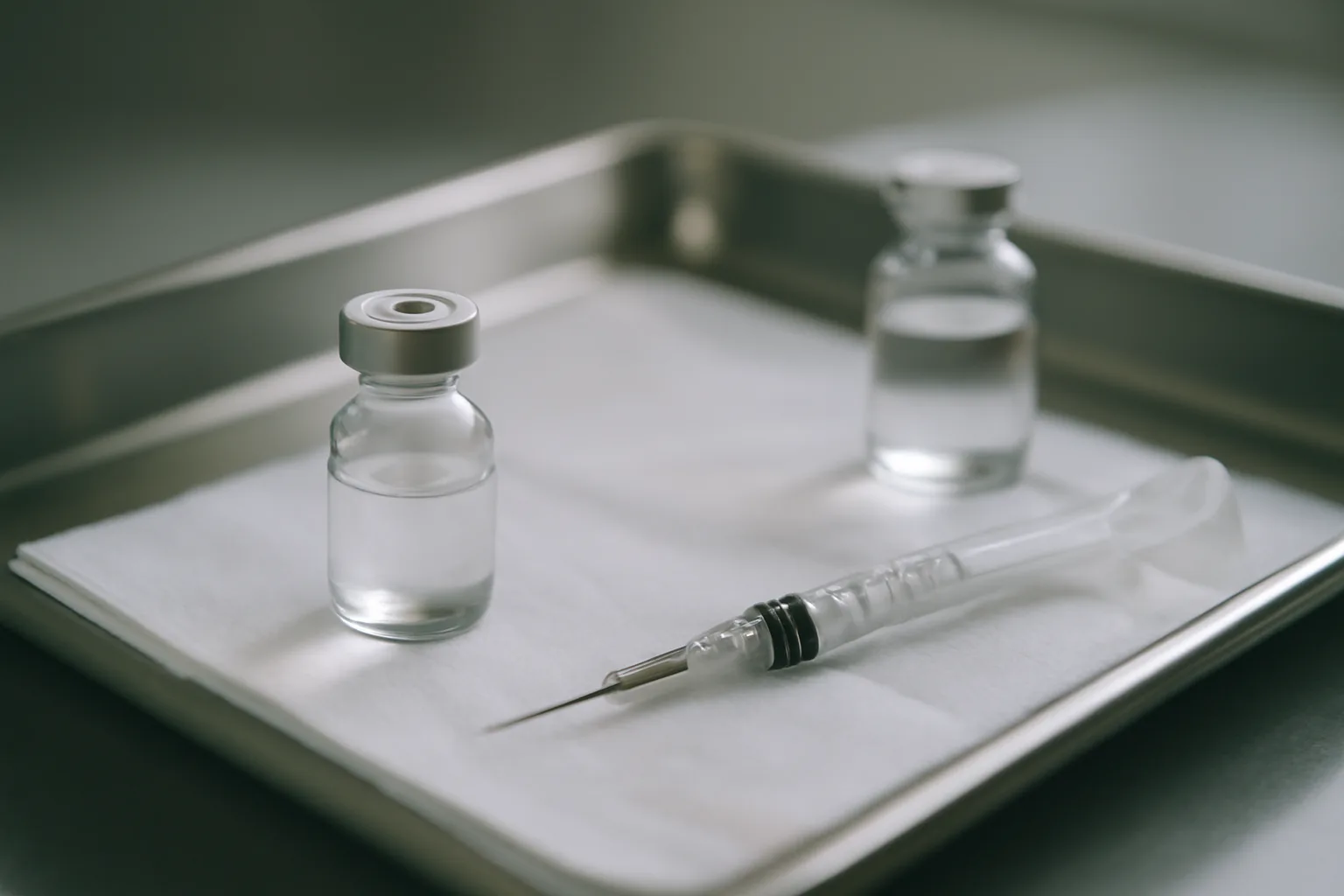
You need four things laid out on a clean, flat surface: the sealed vial of lyophilized epitalon, a vial or ampule of bacteriostatic water (0.9% benzyl alcohol preserved, USP grade), a syringe with a needle fine enough to draw water and pierce the rubber stopper (an insulin syringe, 29-31 gauge, works for most home reconstitution), and alcohol swabs. Bacteriostatic water is not the same as sterile water for injection. Bacteriostatic water contains a preservative that inhibits bacterial growth over the days or weeks you'll be drawing from the same vial. Sterile water without a preservative is meant for a single immediate use and shouldn't sit around for repeat dosing. USP's sterile compounding standards treat these as distinct products for exactly this reason [1]. Wipe the rubber tops of both vials with an alcohol swab before inserting any needle. This single habit is the biggest lever you have against contaminating a multi-week supply.
How much bacteriostatic water should you add?
There's no single official reconstitution volume because epitalon isn't an FDA-approved drug with a package insert. What exists instead is a working range compounding pharmacies and peptide researchers commonly use: roughly 1-3 mL of bacteriostatic water per 5-10 mg vial, adjusted based on the dose you want per injection and the syringe markings you're using. More diluent means a lower concentration per mL and finer control over small doses, but it also means more frequent injections of the same total volume, and you burn through the vial faster if your target dose per shot is small. Less diluent gives you a more concentrated solution, useful if you're dosing on the low end (many protocols cited for epitalon run 5-10 mg per day) and want to keep injection volume small. A practical example: mixing 10 mg of epitalon with 2 mL of bacteriostatic water gives a 5 mg/mL solution. On a standard U-100 insulin syringe (100 units = 1 mL), that means 1 mg equals 20 units. If your target is 5 mg, you'd draw 100 units (1 mL). Run the actual math for your vial size and target dose with the epitalon dosage calculator before you draw anything, and cross-check against the ranges discussed on the epitalon dosage page.
What's the step-by-step reconstitution process?
Wash your hands and wipe down your work surface. Swab both vial tops with an alcohol pad and let them air dry for a few seconds; wiping and immediately piercing defeats the point. Draw the bacteriostatic water into your syringe first, pulling back to your target volume (say, 2 mL). Insert the needle into the water vial at a slight angle if it's a stopper-top vial, draw the water, then remove any air bubbles by tapping the syringe and pushing the plunger slightly. Insert the needle into the epitalon vial through the rubber stopper. Angle the needle so the water stream runs down the interior glass wall, not directly onto the powder. Push the plunger slowly. Hitting the powder dead-on with a fast stream is the single most common cause of a peptide foaming or clumping. Withdraw the needle. Swirl the vial gently between your palms, or set it down and let it sit for a minute, then swirl again. Do not shake it. Shaking introduces mechanical stress that can denature the peptide's structure, the same reason vaccine handling guidance commonly warns against shaking certain biologic products [2]. Give it a few minutes; most peptide powders fully dissolve into a clear solution within 5-10 minutes without any force at all.
What if the powder won't dissolve?
Clear, no particles, no cloudiness, that's what you're aiming for. If you still see visible flecks after several minutes of gentle swirling, let the vial sit undisturbed for 15-20 minutes at room temperature and try swirling again. Persistent cloudiness or visible particulate matter that won't resolve is a reason to stop and not use the vial. It can indicate the peptide degraded before you got it, that the water introduced a contaminant, or that the powder was manufactured with excess salt or buffer content that isn't fully soluble. Discard rather than inject anything with visible particles; this mirrors standard USP guidance on parenteral products, which calls for solutions to be checked for particulate matter before administration [1]. A solution that turns cloudy after successful initial reconstitution, days into storage, is telling you it has degraded or become contaminated. Same rule applies: don't use it.
How should reconstituted epitalon be stored?
Refrigerate it, don't freeze it. Standard advice across peptide compounding literature is 2-8°C (36-46°F), which is your typical home refrigerator, not the freezer door and not the back wall where it might ice over. Keep the vial upright, away from light, and away from the fridge door where temperature swings are largest every time it opens. Most sources estimate a reconstituted peptide solution's usable window at somewhere between 20 and 30 days when refrigerated and kept sterile, a range that comes from general peptide stability practice rather than a study specific to epitalon. Because there's no manufacturer insert or FDA-approved labeling for epitalon (it isn't an approved drug in the US, UK, or EU), there's no authoritative expiration date to cite. Treat 3-4 weeks as a reasonable outer limit and err toward the shorter end if you've drawn from the vial many times, since every needle insertion is a small risk of introducing contamination even with a preserved diluent.
Can you travel with or ship reconstituted epitalon?
Short trips in an insulated bag with an ice pack are fine for a few hours; that's the same logic used for insulin and other refrigerated peptides. For anything longer, you're relying on the bacteriostatic preservative and hoping the temperature excursion is brief. Air travel raises separate legal questions that have nothing to do with reconstitution technique. Epitalon is not an FDA-approved drug, and the FDA's compliance program for unapproved compounded and research-labeled products documents the agency's authority to act against unapproved drug products marketed for human use [3]. Crossing borders with an unapproved, unlabeled injectable peptide is a genuinely different risk category than storing it in your kitchen fridge, and that risk exists independent of whether you reconstituted it perfectly.
Is homemade reconstitution safe, or should a pharmacy do it?
Doing it yourself at home is common in the peptide research community, but it carries real risks that a licensed compounding pharmacy is built to control for: sterile technique under a laminar flow hood, verified diluent purity, batch testing for endotoxins, and documented expiration dating. USP's sterile compounding chapter lays out exactly why this matters: compounded sterile preparations carry contamination risk if proper aseptic processing isn't followed, which is the basis for the particulate-free standard referenced above [1]. A home kitchen counter, however clean it looks, is not a controlled sterile environment. If you're going to use epitalon at all, the safer version of this whole process is sourcing it already reconstituted, or working through a provider who orders from a legitimate compounding pharmacy rather than mixing vials yourself from an unregulated powder supplier. See buy epitalon for how that sourcing question plays out, and Epitalon Rx's provider-reviewed pathway is built around exactly this: connecting people to fulfillment through a licensed compounding pharmacy rather than DIY vial-mixing from unverified powder.
Does reconstitution method affect whether epitalon actually works?
No. Getting the mixing technique perfect doesn't change the deeper problem, which is that the evidence for epitalon's headline claims, telomerase activation and lifespan extension, comes almost entirely from a small group of Russian researchers, led by Vladimir Khavinson at the St. Petersburg Institute of Bioregulation and Gerontology, over the past two to three decades. Their published work includes studies in mice and rats showing epithalon (the peptide is called epithalon in most of this literature) increased lifespan in certain rodent strains and activated telomerase in some human cell cultures in vitro [4][5]. One frequently cited paper reported that epithalon increased telomerase activity in a human epithelial cell line in culture [5]. Another followed cancer-prone mice and reported effects on tumor incidence and lifespan under specific dosing schedules [4]. These are legitimate lab findings, but they are rodent and cell-culture findings, not human trial results. There is no published randomized controlled trial in humans measuring epitalon's effect on telomere length, telomerase activity, or lifespan. No regulatory body, not the FDA, not the EMA, has approved epitalon for any indication, and it is not included in any WHO essential medicines listing. Independent labs outside this Russian research group have not replicated the core telomerase and lifespan findings in peer-reviewed literature that we could locate. That gap between rodent-and-cell-culture evidence and human outcome claims is the single most important thing to understand before anyone reconstitutes a vial, and it's covered in full on the epithalon hub page.
What are the practical risks of injecting reconstituted epitalon?
Beyond the unproven efficacy question, there are concrete injection-related risks worth naming plainly. Injection site reactions (redness, mild swelling, soreness) are the most commonly reported issue in anecdotal and small-scale peptide use reports. Because epitalon products sold online are not FDA-regulated pharmaceuticals, there's no guarantee of purity, correct peptide identity, or sterility unless the supplier provides third-party testing (a certificate of analysis with mass spec and endotoxin results). Contaminated or misidentified peptide is a real and documented risk category across the unregulated peptide market broadly, an area the FDA has addressed directly in its guidance on compounding using bulk drug substances not yet evaluated for safety in compounded products [6]. The epitalon side effects page covers what's actually been reported anecdotally and in the limited animal literature. If you're set on trying it despite the evidence gaps, minimizing risk means buying from a source that provides batch-specific purity testing, using correct sterile technique for reconstitution and injection, rotating injection sites, and not exceeding the modest dose ranges discussed in epitalon peptide injections guidance drawn from the existing (thin) literature.
Quick reconstitution troubleshooting checklist
Solution is cloudy right after mixing: don't force it, let it sit 15-20 minutes and swirl gently again before giving up on the vial. Solution foamed when you added the water: you probably hit the powder directly with the stream; next time angle the needle toward the glass wall. Vial has been in the fridge for over a month: discard it. There is no manufacturer expiration data to fall back on for edge cases, so treat the conservative 3-4 week window as a hard stop, not a suggestion. You're not sure of the concentration you ended up with: stop and redo the math rather than guess; injecting an unknown concentration defeats the entire purpose of careful reconstitution. Use the epitalon dosage calculator to check your numbers against your vial size.
Frequently asked questions
What liquid do you use to reconstitute epitalon?
Bacteriostatic water (0.9% benzyl alcohol, USP grade) is the standard diluent, not sterile water without a preservative. The preservative in bacteriostatic water inhibits bacterial growth across the multiple days or weeks you'll be drawing from the same vial, which plain sterile water for injection isn't designed for.
How much bacteriostatic water do you add to 10mg of epitalon?
There's no official figure since epitalon has no FDA-approved labeling, but a common working range is 1-3 mL for a 10 mg vial. Mixing with 2 mL gives a 5 mg/mL solution, a concentration many people use to keep injection volumes manageable for typical dose ranges.
Can you shake epitalon to help it dissolve?
No. Shaking can mechanically stress and denature the peptide structure. Add the water slowly down the vial wall and swirl gently between your palms instead; most peptide powders fully dissolve within 5-10 minutes without force.
How long does reconstituted epitalon last in the fridge?
Most peptide compounding sources estimate roughly 20-30 days when refrigerated at 2-8°C and handled with sterile technique. This is a general peptide stability estimate, not a figure specific to epitalon studies, since there's no manufacturer insert to cite.
Is epitalon and epithalon the same thing?
Yes. Epitalon and epithalon refer to the identical synthetic tetrapeptide (Ala-Glu-Asp-Gly). The spelling varies mostly by source: much of the original Russian research literature uses "epithalon," while commercial listings more often use "epitalon."
Does epitalon need to be refrigerated before reconstitution?
The freeze-dried powder is more stable than the liquid form and many suppliers ship it at room temperature, but refrigeration before use is still the safer default and is required after reconstitution. Once mixed with bacteriostatic water, refrigeration at 2-8°C is standard practice.
What happens if you inject cloudy reconstituted epitalon?
Don't do it. Visible cloudiness or particulate matter after mixing or during storage indicates degradation or contamination. USP standards for injectable solutions call for them to be checked for visible particulates before use; discard any vial that doesn't meet that bar.
Is there human evidence that epitalon extends lifespan?
No published randomized controlled human trial has measured epitalon's effect on human lifespan or telomere length. The lifespan and telomerase claims come from rodent studies and human cell-culture experiments by a Russian research group, primarily at the St. Petersburg Institute of Bioregulation and Gerontology, not from human clinical trials.
Who is Vladimir Khavinson and why does his name come up with epitalon?
Khavinson led the St. Petersburg Institute of Bioregulation and Gerontology research group that produced most of the published epithalon studies, including rodent lifespan experiments and cell-culture telomerase work. Nearly all widely cited epitalon efficacy claims trace back to this one research group's publications.
Is epitalon legal to buy and use in the United States?
Epitalon is not FDA-approved for any human use and is typically sold labeled 'for research use only.' The FDA's guidance on compounded drug products using bulk substances addresses exactly this category of unapproved peptide, so buying it for personal injection sits in a legal gray area rather than a clearly sanctioned one.
What gauge needle should you use to reconstitute and inject epitalon?
A fine insulin-style syringe, typically 29-31 gauge, is standard for both drawing bacteriostatic water and subcutaneous injection. Finer gauges reduce injection discomfort; the same syringe can usually handle both the reconstitution draw and the injection itself.
Can you use epitalon straight from the vial without reconstituting?
No. Epitalon ships as a freeze-dried powder and has no injectable use until it's dissolved in a sterile liquid diluent. Attempting to inject the dry powder isn't possible with standard syringes and isn't how any peptide of this type is administered.
Sources
- USP General Chapter <797> Pharmaceutical Compounding - Sterile Preparations (US Pharmacopeia): Sterile parenteral products must be checked for visible particulates and follow aseptic processing standards
- CDC, Vaccine Storage and Handling Toolkit: Injectable biologic products are commonly labeled to avoid shaking because mechanical agitation can damage the product
- FDA Compliance Policy Guide Sec. 460.200, Compounding of Drugs for Use in Humans: FDA compliance guidance addresses unapproved drug products, including compounded and research-labeled substances marketed for human use
- Khavinson VK et al., 'Peptide Regulation of Aging: Results and Prospects,' PMID 11693303: Epithalon studies in mice reported effects on lifespan and tumor incidence under specific dosing schedules
- Khavinson VK, Bondarev IE, Butyugov AA, 'Epithalon peptide induces telomerase activity and telomere elongation in human somatic cells', PMID 14631478: Epithalon increased telomerase activity in a human epithelial cell line in vitro
- FDA Guidance for Industry, 'Prioritization of the Nominations of Bulk Drug Substances for Use in Compounding Under Section 503A of the FD&C Act': FDA guidance addresses bulk drug substances, including peptides, nominated for use in compounding and the safety evaluation gaps involved