Last updated 2026-07-26
TL;DR
Epitalon (epithalon) is typically reconstituted with bacteriostatic water and injected subcutaneously, often 5-10mg daily for 10-20 days, then cycled off for months. Most protocol detail traces back to Russian studies from the Khavinson group, not independently replicated trials, so treat dosing numbers as tradition rather than proven optimal.
What is Epitalon and why is it injected instead of taken orally?
Epitalon (also spelled epithalon, and sometimes called Epithalone) is a synthetic tetrapeptide, Ala-Glu-Asp-Gly, modeled on a natural pineal gland compound called epithalamin [1]. It's injected because peptides this small still get broken down by stomach acid and digestive enzymes before they can reach the bloodstream intact. Subcutaneous injection skips the gut entirely, so the peptide reaches circulation without being chewed up first. There is no approved oral Epitalon product with human absorption data behind it. Some sellers market oral capsules or sublingual drops, but there is no published pharmacokinetic study showing meaningful bioavailability by that route. If you're going to use Epitalon at all, the injectable route is the one with any research history behind it, thin as that history is. The research base itself is worth naming clearly here: almost everything cited for Epitalon's telomerase and lifespan effects comes from one Russian research group led by Vladimir Khavinson, working out of the Saint Petersburg Institute of Bioregulation and Gerontology [2]. Their rodent and human studies were mostly not replicated by independent labs outside that group. That doesn't mean the compound does nothing, but it does mean the injection protocols floating around online are extrapolated from a narrow evidence base, not a broad consensus.
How do you reconstitute Epitalon powder for injection?
Epitalon typically ships as a lyophilized (freeze-dried) powder in a vial, usually 10mg or 50mg per vial, and needs to be mixed with a liquid before it can be drawn into a syringe. Bacteriostatic water (water with 0.9% benzyl alcohol as a preservative) is the standard diluent used for multi-dose peptide vials because it stays sterile longer than plain sterile water once the vial is punctured [3]. A common approach: add 2mL of bacteriostatic water to a 10mg vial, giving a concentration of 5mg/mL. Some people use less water (1mL) for a more concentrated 10mg/mL solution, which means smaller injection volumes. There's no single correct dilution, it's a tradeoff between injection volume and how finely you can measure small doses with the syringe markings you have. When reconstituting, let the water run down the side of the vial slowly rather than spraying it directly onto the powder, and swirl gently rather than shaking. Peptides can denature (lose structure) under rough physical agitation, though Epitalon's small size makes it fairly tolerant compared to larger peptides. Once mixed, bacteriostatic water reconstituted peptide is generally considered stable for about 28 days when refrigerated, based on general guidance for bacteriostatic water shelf life after multi-dose use, though this is a general pharmacy handling convention rather than an Epitalon-specific stability study [3]. Store the reconstituted vial in the refrigerator, not the freezer, and don't leave it at room temperature for extended periods.
What supplies do you need before you inject?
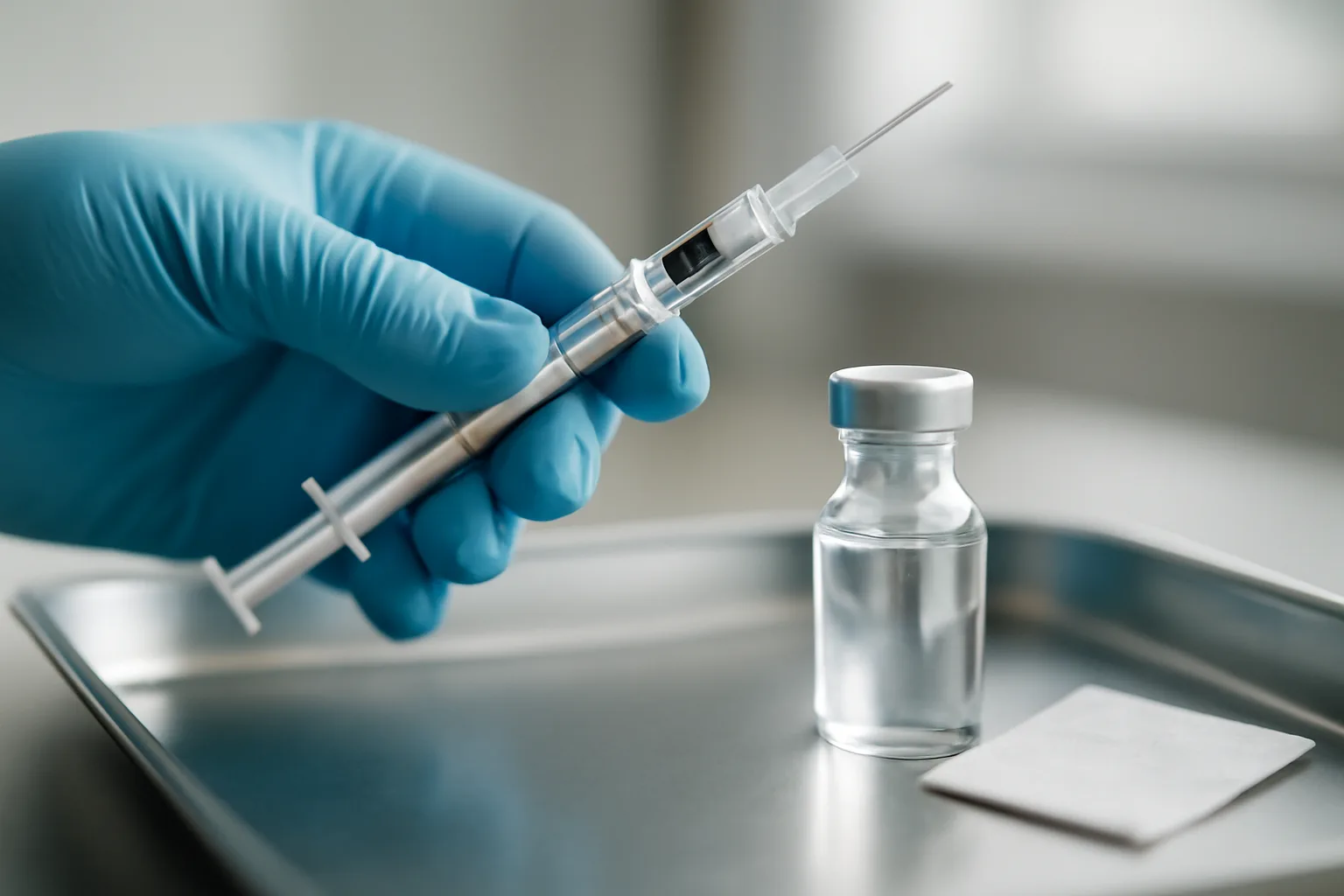
Beyond the peptide vial and bacteriostatic water, you need: insulin syringes (typically 0.5mL or 1mL, 29-31 gauge needles are standard for subcutaneous peptide injections), alcohol swabs, a sharps disposal container, and clean hands or gloves. Insulin syringes are marked in units (100 units = 1mL) which makes precise small-volume dosing much easier than trying to use a standard syringe. If your reconstituted solution is 5mg/mL, then 10mg is 2mL, which is 200 units on an insulin syringe, requiring two syringes or one 1mL/100-unit syringe filled twice, or a single 3mL syringe if your dose is larger. Most people prefer a more concentrated mix specifically so the daily dose fits into one syringe pull. A sharps container matters more than people think. Loose needles in household trash are a real injury risk to sanitation workers and family members, and many U.S. states have specific rules about medical sharps disposal through household hazardous waste programs rather than regular trash [4].
Where and how do you inject Epitalon subcutaneously?
Subcutaneous injection means depositing the liquid into the fatty layer just under the skin, not into muscle. Common injection sites are the abdomen (at least two inches from the navel), the outer thigh, or the back of the upper arm, the same sites used for insulin injections. Step by step: wipe the injection site with an alcohol swab and let it air dry for a few seconds. Pinch a fold of skin between two fingers to lift the fatty tissue away from the muscle. Insert the needle at a 45 to 90 degree angle depending on your body fat at that site (thinner people generally use 45 degrees to avoid hitting muscle). Push the plunger slowly and steadily. Withdraw the needle and press a clean cotton ball or gauze on the site for a few seconds; don't rub it. Rotate injection sites day to day. Using the exact same spot repeatedly can cause local irritation, small lumps under the skin (lipohypertrophy), or bruising over time. This is standard advice from insulin injection guidance and applies the same way to any subcutaneous peptide. For readers who want the underlying dosing math worked out for their specific vial size and target dose, the epitalon dosage calculator walks through volume-per-dose conversions, and epitalon peptide injections covers injection frequency choices in more depth.
What dose of Epitalon do people actually use?
| Daily dose | 5-10mg |
|---|---|
| Course length | 10-20 days |
| Courses per year | 1-2 |
| Route | Subcutaneous injection |
| Reconstitution diluent | Bacteriostatic water |
The dose most commonly cited in both the Russian clinical literature and in the peptide-using community is 5-10mg per day, injected once daily, for a course of 10 to 20 consecutive days [2] [5]. Some protocols split this into 5mg twice daily, though there's no strong pharmacokinetic reason given for splitting versus single dosing since Epitalon's half-life in circulation is very short. Here is the range as reported across sources: | Parameter | Typical range reported | These numbers come almost entirely from the Khavinson group's published protocols, which used various dosing schedules across different studies in elderly human subjects and in rodents, generally aimed at pineal gland and melatonin-related outcomes rather than a formally optimized anti-aging dose-response curve [2]. Nobody has published a randomized, dose-ranging trial in humans that tells you whether 5mg or 10mg is better, or whether 10 days is meaningfully different from 20. The dosing tradition is inherited, not derived from head-to-head comparison.
How long does an Epitalon injection cycle last, and how often do you repeat it?
A standard cycle runs 10 to 20 days of daily injections, followed by a break of several months, commonly cited as twice a year, often timed to season changes (spring and autumn) in the original Russian protocols, tied loosely to their hypothesized effect on pineal gland and circadian/seasonal hormone regulation [2]. There's no human trial establishing that twice yearly is superior to once yearly or three times yearly. The seasonal framing comes from the pineal gland's role in melatonin production, which itself has a seasonal photoperiod component, but that's a physiological rationale, not a tested outcome. If you want the fuller reasoning on cycle timing and the tradeoffs between longer and shorter courses, see Epitalon cycle length. Some users repeat cycles more frequently, running a 10-day course monthly. There is no published safety or efficacy data on that schedule specifically; it's an extrapolation, not a studied protocol.
What does the actual telomerase and lifespan evidence show?
This is the part that matters most and gets flattened the most online. The strongest claims, that Epitalon extends telomeres, activates telomerase, and extends lifespan, come from a small number of studies, mostly from Khavinson's own institute, using rodent models and cell culture, with a few small human observational studies layered on top [2] . One frequently cited study found that Epitalon increased telomerase activity and elongated telomeres in cultured human somatic cells in vitro . That is a cell-culture finding, not a human clinical outcome. It tells you Epitalon can do something to telomerase in a dish under specific conditions; it does not tell you injecting it into a person changes their telomere length, extends their lifespan, or reverses any aging marker in vivo. On the rodent side, some of the group's own studies reported reduced spontaneous tumor incidence and modest lifespan extension in mice given Epitalon, published in journals like Biogerontology and similar venues associated with the same research network [2]. Rodent lifespan and cancer-incidence studies are useful signals, but mouse biology and human biology diverge substantially, especially around telomere dynamics (mice have much longer telomeres and different telomerase regulation than humans to begin with). The human data that exists is largely small-scale and mostly from the same Russian institute, without the kind of large, independent, randomized, placebo-controlled replication that would let an outside researcher call this settled [2]. As of now, no major Western regulatory body or independent academic consortium has replicated a human telomere-lengthening or lifespan-extension outcome for Epitalon. If you're evaluating this compound the way you'd evaluate any other longevity intervention, the honest label is: promising mechanistic signal from one research group, not independently confirmed in humans.
Is Epitalon legal to buy and inject, and is it FDA approved?
Epitalon is not FDA approved for any use in the United States. It is not a dietary supplement under FDA's definitions, and it is sold, when it is sold in the U.S. market, almost always labeled 'for research purposes only,' which is a legal fiction sellers use to avoid making drug claims rather than an accurate description of how buyers actually use it . The FDA has taken broader action against unapproved peptide products sold for human use, including warning letters to compounding pharmacies and firms marketing peptides like BPC-157 and others outside approved channels, and Epitalon falls into that same general regulatory gray zone: not a scheduled controlled substance, but not an approved drug either . That means quality control, sterility, and actual peptide content in any given vial are not guaranteed by any regulatory body checking the manufacturer's work. If you're going to use it anyway, the safer sourcing path is one that at least puts a clinician in the loop and uses a pharmacy that does third-party identity and purity testing, rather than an anonymous research-chemical storefront. Epitalon Rx's provider-reviewed pathway connects buyers with a fulfilling pharmacy partner rather than shipping directly from an unregulated peptide vendor, which at minimum adds a layer of clinical review and lab verification that most gray-market Epitalon sources skip entirely.
What are the side effects and risks of injecting Epitalon?
Reported side effects in the existing human studies are mild and mostly injection-related: redness, itching, or mild swelling at the injection site, and occasional headache [2] [5]. There is no large-scale, independently run safety trial in humans, so absence of reported serious side effects reflects thin data, not proof of safety at scale. The more relevant risk for most users is injection technique and sourcing, not the peptide's pharmacology. Injecting with a shared or reused needle, injecting into muscle rather than fat, injecting an unverified or contaminated vial, or injecting improperly reconstituted powder are the things actually likely to cause problems. Standard subcutaneous injection hygiene (single-use needles, alcohol prep, proper site rotation) mitigates most of the practical risk. Because independent long-term human safety data doesn't exist, anyone with a cancer history, autoimmune condition, or existing endocrine disorder should treat Epitalon as an unknown, not a known-safe compound, and involve a physician before starting rather than after.
How do you know if the injections are working?
Honestly, you mostly won't, at least not from subjective feel. Epitalon isn't a stimulant peptide with an immediate perceptible effect like some growth hormone secretagogues. Its claimed effects (telomere maintenance, pineal/melatonin regulation) are the kind of thing that, if real in humans at all, plays out over years, not days. Some users report better sleep quality during and after a cycle, plausibly linked to the compound's proposed effect on melatonin regulation via the pineal gland, but this is self-reported and not measured against placebo in the available literature [2]. There is no validated at-home biomarker test that tells you your telomerase activity changed in response to a course of Epitalon; commercial telomere-length tests exist but have real accuracy and interpretation limitations even in dedicated aging-biomarker research settings. For a realistic look at what people report anecdotally versus what's actually measured, epitalon peptide before and after goes through the self-report landscape without pretending it's clinical data.
How does injecting Epitalon compare to other administration approaches people mention?
Subcutaneous injection is the only route with any research history behind it. Nasal sprays and oral capsules are sold commercially but have essentially no published human bioavailability data for this specific peptide; small tetrapeptides are generally degraded quickly by nasal and gut enzymes, so claims of equivalent effect through those routes should be treated skeptically absent actual pharmacokinetic comparison [1].
| Route | Research support | Practical notes |
|---|---|---|
| Subcutaneous injection | Basis for essentially all published dosing data | Requires reconstitution and injection technique |
| Oral capsule | No published bioavailability data | Peptide likely degraded in GI tract |
| Nasal spray | No published bioavailability data | Absorption unverified for this peptide |
If you're choosing a route based on what the actual research used, injection is the only defensible choice right now. For a broader look at how injection frequency and site choice affect the overall experience, epitalon peptide injections and how to take epitalon peptide both go deeper into day-to-day practice.
What is Epitalon's half-life, and why does that matter for injection timing?
Epitalon has a very short half-life in circulation, generally described as a matter of minutes once injected, because small linear peptides like this are quickly broken down by peptidases in the blood [1] [2]. This is part of the rationale the original researchers gave for daily dosing rather than dosing every few days: whatever biological signal the peptide triggers happens fast and then it's cleared. This short half-life also means there's no meaningful 'buildup' argument for taking it multiple times a day versus once; the peptide isn't accumulating to a steady blood concentration the way a long half-life drug would. For the full pharmacokinetic detail and what it implies for cycle design, see Epitalon half life.
Frequently asked questions
Is Epitalon the same as epithalon?
Yes. Epitalon and epithalon (sometimes epithalone) refer to the same synthetic tetrapeptide, Ala-Glu-Asp-Gly. The spelling varies by seller and by translation from the original Russian research literature, but the compound is identical.
Can you inject Epitalon into muscle instead of subcutaneously?
The published protocols and most user practice use subcutaneous injection, not intramuscular. There's no research comparing intramuscular administration for Epitalon specifically, so switching routes means leaving the only route with any evidence behind it.
How much bacteriostatic water do you mix with a 10mg Epitalon vial?
There's no fixed standard, but 1-2mL is typical, giving a concentration of 5-10mg/mL. More water means a more dilute solution and larger injection volume; less water gives a more concentrated, smaller-volume shot. Choose based on your syringe's measurement precision.
What gauge needle is used for Epitalon injections?
Insulin syringes with 29-31 gauge needles are standard for subcutaneous peptide injections, the same needles used for insulin. These are thin enough to minimize discomfort and appropriately short for fatty tissue injection rather than muscle.
How long can reconstituted Epitalon be stored?
General bacteriostatic water guidance suggests reconstituted peptides stay usable for about 28 days when refrigerated, though this is a general pharmacy convention, not an Epitalon-specific stability study. Keep it refrigerated, not frozen, and discard after that window.
Does Epitalon actually lengthen telomeres in humans?
There's no independently replicated human study showing Epitalon lengthens telomeres in vivo. The telomerase-activation evidence is from cell culture and rodent studies, mainly from one Russian research group. Treat the human telomere claim as unproven, not established.
Is Epitalon FDA approved?
No. Epitalon has no FDA approval for any indication in the United States and is not a legal dietary supplement. It's typically sold labeled for research use only, a legal workaround rather than an accurate use description.
How many days in a row do you inject Epitalon?
Most protocols run 10 to 20 consecutive daily injections per course, repeated once or twice a year. This comes from the original Russian dosing schedules, not from a dose-ranging clinical trial establishing an optimal course length.
What's the typical daily dose of Epitalon?
Most cited protocols use 5-10mg per day, injected subcutaneously once daily. Some split doses into 5mg twice daily, though there's no strong pharmacokinetic rationale for splitting given the peptide's short circulating half-life.
Can you feel Epitalon working right after an injection?
No. Epitalon isn't a stimulant peptide with immediate subjective effects. Any claimed benefits relate to long-term processes like telomere maintenance or melatonin regulation, which wouldn't be perceptible shot to shot.
What sites are best for injecting Epitalon subcutaneously?
The abdomen (away from the navel), outer thigh, and back of the upper arm are standard subcutaneous injection sites, the same ones used for insulin. Rotate sites daily to avoid irritation or lumps under the skin.
Is it safe to inject Epitalon yourself at home?
Millions of people safely self-inject insulin and other subcutaneous medications at home using proper technique, so the injection mechanics aren't the main risk. The bigger unknowns are peptide sourcing quality and the lack of independent long-term human safety data for Epitalon itself.
Sources
- PubChem, Epithalon compound summary: Epitalon/epithalon is a synthetic tetrapeptide, Ala-Glu-Asp-Gly, modeled on the natural pineal peptide epithalamin
- Khavinson et al., Biogerontology, peptide bioregulation of aging research summary: Most Epitalon telomerase, lifespan, and dosing protocol data originates from the Saint Petersburg Institute of Bioregulation and Gerontology research group
- EPA, Household Sharps Disposal Guidance: Used needles and sharps require specific disposal handling rather than regular household trash
- NIH MedlinePlus, How to Give an Insulin Injection: Subcutaneous injection technique and site rotation guidance for insulin applies to similar subcutaneous peptide injections
- Khavinson et al., in vitro telomerase activity study: Epitalon increased telomerase activity and elongated telomeres in cultured human somatic cells in an in vitro study