Last updated 2026-07-26
TL;DR
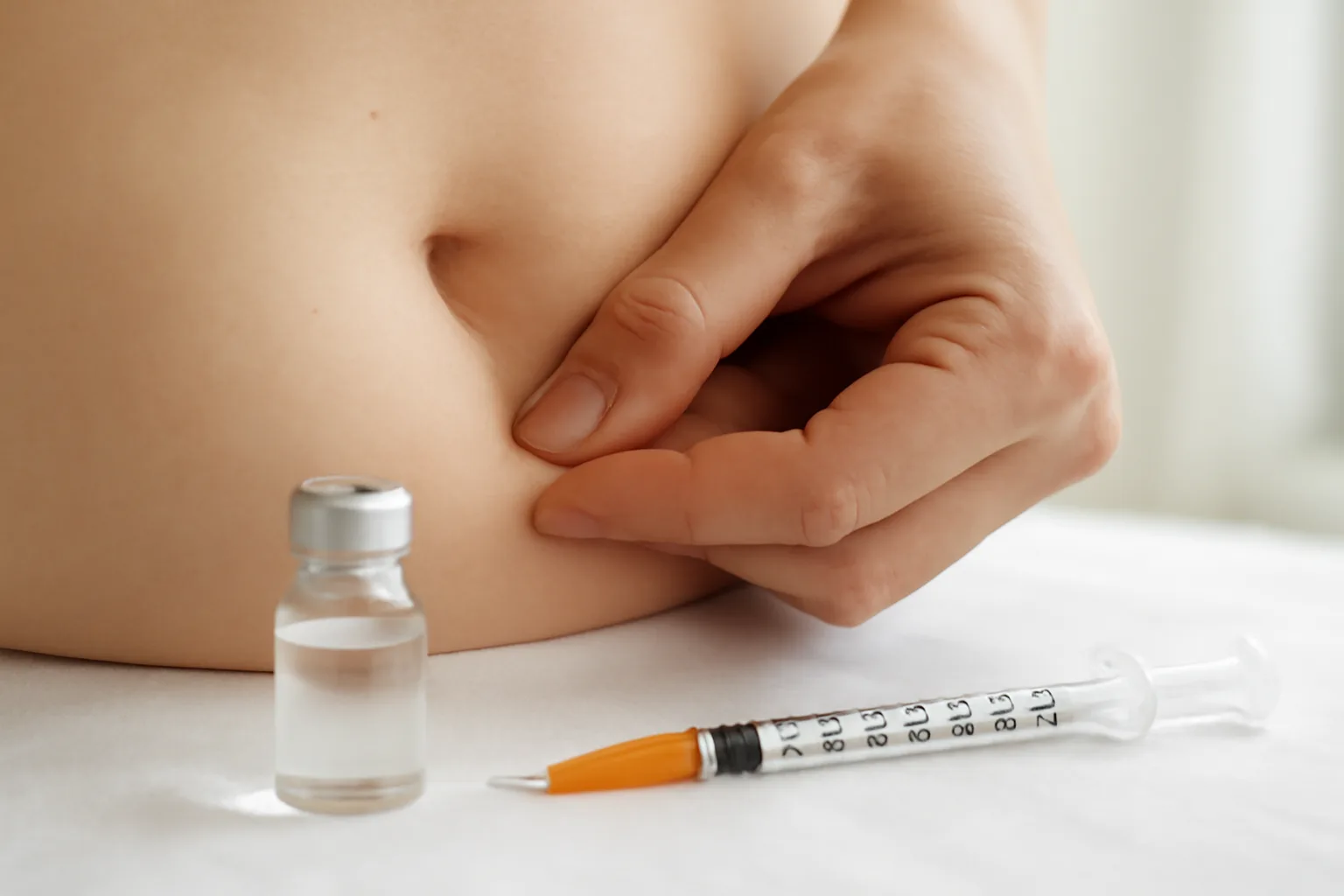
Most people who inject epitalon use the subcutaneous route, pinching skin on the abdomen, thigh, or upper arm, similar to insulin injections. There's no dedicated human clinical protocol establishing an optimal site. Rotation prevents local irritation. This is an unapproved research compound, so no regulatory body has issued injection site guidance.
Where do people inject epitalon?
The overwhelming majority of reported epitalon use is subcutaneous (SubQ), meaning the peptide is injected into the fatty layer just under the skin rather than into muscle or a vein. Common sites mirror those used for insulin and other small-volume peptide injections: the abdomen (avoiding a two-inch radius around the navel), the front or outer thigh, the upper arm's back/outer area, and sometimes the upper glute area. There's no epitalon-specific clinical trial that compares injection sites head to head. The site guidance circulating online is borrowed almost entirely from general subcutaneous injection technique used for insulin, growth hormone, and other peptides, not from epitalon-specific pharmacokinetic data. That distinction matters for anyone trying to evaluate the evidence rather than just follow a habit. The original Russian research on this peptide, led by Vladimir Khavinson's group at the St. Petersburg Institute of Bioregulation and Gerontology, used intramuscular and subcutaneous injections in animal studies and in the small human trials they published, but their papers focus on dosing and outcome measures (telomere length, hormonal markers), not on comparing injection depth or anatomical site [1][2]. If you're looking for a rigorously tested "best" site, it doesn't exist in the literature.
Is epitalon injected subcutaneously or intramuscularly?
Both routes appear in the source material, but subcutaneous is what most current users and compounding guidance default to. Subcutaneous injections are shallower, generally less painful, and easier to self-administer with an insulin syringe (typically 29-31 gauge, 0.5 inch or shorter needle). Intramuscular (IM) injection goes deeper, into muscle tissue, and was used in some of the original Russian animal and small human studies [1]. IM may lead to somewhat faster absorption for some peptides because muscle tissue is more vascular than subcutaneous fat, but nobody has published a controlled comparison of SubQ versus IM epitalon in terms of bioavailability, half-life, or any downstream outcome. Anyone claiming one route is "more effective" for epitalon specifically is going beyond what the data supports. For a peptide with a short reported half-life and no established therapeutic window in humans, the practical difference between SubQ and IM may be trivial. The bigger issue is that neither route has been validated by a regulatory-grade human trial for anti-aging outcomes in the first place. See our epithalon evidence review for the underlying research quality problem this creates.
How do you prepare an epitalon injection site?
Basic aseptic technique: wash hands, wipe the injection site with a fresh alcohol swab, let it air dry for a few seconds (alcohol still wet on the skin stings more and doesn't sterilize any better), and use a new sterile needle each time. Reusing needles, even on yourself, raises infection risk and dulls the needle, which makes the injection more painful and more likely to cause bruising. Pinch a fold of skin (subcutaneous fat) between two fingers, insert the needle at roughly a 45 to 90 degree angle depending on your body fat and needle length, and push the plunger slowly. Don't aspirate (pull back on the plunger to check for blood) for standard peptide SubQ injections; that's an older technique that current CDC guidance no longer emphasizes for routine subcutaneous injections [3]. After injecting, apply light pressure with a clean gauze pad if there's any bleeding. Don't rub the site hard immediately after, since that can increase bruising and local irritation.
Which injection sites should you rotate between?
Rotating sites is standard practice for any peptide or hormone injected repeatedly over weeks, and epitalon protocols (typically 10-20 daily injections per cycle, per Khavinson's published dosing) are no exception [2]. Repeated injections into the exact same square inch of skin cause lipohypertrophy (a lumpy fat buildup), bruising, and localized inflammation that makes future injections both more painful and less predictable in absorption. A simple rotation: alternate left and right sides of the abdomen day to day, and every few days switch to the thigh or upper arm. Keep at least an inch of separation between consecutive injection points within the same general area. If a site is still sore, red, or bruised from the day before, skip it and use a different location. For context on how many injections a typical epitalon course involves and why rotation matters more over a full cycle, see epitalon dosage.
Does injection site affect epitalon's telomerase or lifespan claims?
No published research answers this, and it's worth being direct about why that matters: the headline claims about epitalon (telomerase activation, telomere lengthening, lifespan extension) come almost entirely from one Russian research group and have not been independently replicated in peer-reviewed, controlled human trials [1][2][4]. Khavinson and colleagues reported telomerase activity increases in human retinal pigment epithelial cells treated with the tetrapeptide in vitro, and lifespan effects in rodent and other animal studies, but a cell-culture or mouse result is not evidence of a human aging outcome [1][4]. Given that the underlying efficacy data itself is thin and un-replicated, questions about optimizing injection site for better telomerase effect are getting ahead of what anyone actually knows. There's no dose-response or route-response curve established in humans. If a vendor or forum post tells you a specific injection site "maximizes telomere benefits," that claim has no cited human trial behind it, because no such trial has been run and published in an independent, peer-reviewed venue. This is the single most important caveat on this whole topic: injection site technique is a real, practical safety question with reasonable answers borrowed from general peptide practice. Injection site's effect on aging outcomes is not a real answered question at all.
What size needle and syringe do you need for epitalon injections?
Most subcutaneous peptide injections use an insulin syringe in the 0.3 mL to 1 mL range with a 29 to 31 gauge needle, typically 5/16 inch (8 mm) to 1/2 inch (12.7 mm) long. These are the same syringes used for insulin and are widely available at pharmacies without a prescription in most US states, though state pharmacy law varies on over-the-counter syringe sales limits. Smaller gauge numbers mean thicker needles; 31 gauge is thinner and generally less painful for shallow SubQ injections than 27 or 29 gauge, but the right choice depends on your reconstituted peptide's viscosity and your own fat layer thickness. A person with less subcutaneous fat may need a shorter needle to avoid hitting muscle unintentionally. Never share syringes or needles, even from the same reconstituted vial, between more than one person. Discard needles in a proper sharps container, not in regular household trash, per local sharps disposal rules (check your city or county's household hazardous waste guidance).
How painful are epitalon injections and how do you reduce discomfort?
Subcutaneous injections are generally described as mild stinging or pressure rather than sharp pain, assuming a thin needle and slow injection speed. Pain reports for epitalon specifically aren't systematically tracked anywhere, but general peptide-injection pain factors apply: injecting cold reconstituted solution straight from the fridge stings more than solution warmed slightly to room temperature first (never microwave or heat it, just let the vial sit out for 10-15 minutes). Injecting too fast causes more discomfort and tissue pressure than a slow, steady push over 5-10 seconds. Numbing the site briefly with an ice cube before the alcohol swab can help people who are needle-sensitive. Areas with more fat, like the lower abdomen, tend to be less sensitive than areas with less padding, like the outer thigh in a lean person. If a site is consistently painful, red for more than a day or two, or develops a hard lump that doesn't resolve within a week, that's a signal to stop using that spot and, if it doesn't improve, talk to a doctor about possible infection or an allergic-type local reaction. Our epitalon side effects page covers the fuller range of reported local and systemic reactions.
Epitalon vs epithalon: does the spelling change anything about injection technique?
No. "Epitalon" and "epithalon" (also seen as "epithalone") refer to the exact same synthetic tetrapeptide, Ala-Glu-Asp-Gly, originally developed and studied by Khavinson's group as a synthetic analog of the pineal gland peptide epithalamin [2]. The spelling difference is a transliteration artifact from Russian sources and vendor naming conventions, not a different compound or formulation. Injection technique, sites, needle gauge, and reconstitution practices are identical regardless of which spelling is on the vial label. If you see a product marketed as having a superior or different injection protocol because of its spelling, that's a marketing distinction with no chemical basis behind it.
What's the difference between injecting reconstituted epitalon and other peptide forms?
Epitalon typically ships as a lyophilized (freeze-dried) powder in a small vial, requiring reconstitution with bacteriostatic water or sterile water before injection. Once reconstituted, the general handling rules for injectable peptides apply: refrigerate the vial (not freeze), use within the timeframe stated by whoever supplied it (commonly cited as roughly 2-4 weeks refrigerated for many reconstituted peptides, though epitalon-specific stability data from a controlled study isn't publicly available), and always inspect the solution for cloudiness or particulates before drawing up a dose. Some vendors sell epitalon as an oral capsule or nasal spray marketed as an alternative to injection, but there's no published human bioavailability data comparing oral or intranasal epitalon absorption to injected forms. Given the peptide's likely susceptibility to degradation by digestive enzymes if swallowed, injection remains the route with the most (still limited) research behind it. For injection frequency and cycle length details tied to the original Russian dosing protocols, see epitalon peptide injections.
What should you do if an injection site gets red, swollen, or infected?
Mild redness and a small bump that resolves within 24-48 hours is common and not usually a concern with proper technique. Warning signs that need medical attention include spreading redness beyond the injection point, warmth, pus or discharge, fever, or pain that worsens rather than improves over a few days; these can indicate a skin infection (cellulitis) that needs antibiotic treatment. Because epitalon is not an FDA-approved drug and is typically obtained through research-chemical channels or compounding pharmacies rather than standard retail pharmacy dispensing, there's no manufacturer-run adverse event reporting system tracking injection site complications specific to this peptide. If something goes wrong, your own doctor and, if serious, the FDA's MedWatch voluntary reporting system are the paths available; there's no epitalon-specific registry [5]. If you're sourcing epitalon at all, doing so through a provider-reviewed pathway rather than an anonymous online vendor at least puts a licensed clinician between you and dosing/administration questions. Epitalon Rx's buy epitalon guide walks through what a provider-reviewed sourcing route looks like and names the pharmacy partners involved in fulfillment.
Do you need a doctor to inject epitalon, or can you self-inject at home?
Most people who use epitalon self-inject at home using the same technique diabetics use for insulin, and this is technically straightforward for a healthy adult who's been shown proper technique once. That said, self-injecting an unapproved research compound at home carries more risk than self-injecting an FDA-approved, dosage-standardized drug like insulin, simply because purity, concentration accuracy, and sterility of the product itself aren't guaranteed by any regulatory approval process the way they are for approved pharmaceuticals. A provider-reviewed pathway, where a clinician evaluates whether epitalon is appropriate for you and the product comes from a pharmacy partner rather than an unregulated research-chemical seller, doesn't eliminate the self-injection step but does add a layer of oversight on the product quality and dosing side. That's a meaningfully different risk profile than ordering an unlabeled vial from an anonymous website and injecting it yourself with no clinical input at all.
Frequently asked questions
What is the best injection site for epitalon?
There's no clinically established "best" site; most users default to subcutaneous injection in the abdomen, thigh, or upper arm, rotating between them to avoid irritation. This mirrors general peptide injection practice, not epitalon-specific research, since no study has compared sites for this compound.
Is epitalon injected subcutaneously or intramuscularly?
Both routes appear in the original Russian research, but subcutaneous injection with an insulin-style syringe is the more common current practice, largely because it's easier to self-administer and generally less painful than intramuscular injection.
How many times can you inject epitalon in the same spot?
You shouldn't repeatedly inject the exact same spot; rotate sites daily or every few days to avoid lipohypertrophy (fatty lumps), bruising, and localized irritation, which are common issues with any repeated subcutaneous injection regimen, insulin included.
Does epitalon injection site affect telomerase activation or lifespan benefits?
No human research addresses this question. Epitalon's telomerase and lifespan claims come from a small Russian research group's cell-culture and animal studies, not from controlled human trials examining injection route or site, so any claim about site optimizing these effects has no evidence behind it.
What needle gauge is used for epitalon injections?
Typically a 29 to 31 gauge insulin needle, 5/16 to 1/2 inch long, used with a 0.3 to 1 mL insulin syringe. This is standard for subcutaneous peptide injection and isn't unique to epitalon.
Can you inject epitalon into your stomach?
Yes, the abdomen is one of the most commonly used subcutaneous injection sites for epitalon, avoiding a roughly two-inch radius around the navel. It's a common insulin injection site too, chosen because it usually has an accessible fat layer.
How do you reconstitute epitalon before injecting?
Epitalon typically arrives as a freeze-dried powder that needs mixing with bacteriostatic or sterile water before injection. Refrigerate the reconstituted vial, inspect for cloudiness before each use, and don't use it past the timeframe specified by your supplier or pharmacy.
Is epitalon and epithalon the same thing for injection purposes?
Yes. Epitalon and epithalon are spelling variants of the same synthetic tetrapeptide (Ala-Glu-Asp-Gly) studied by Vladimir Khavinson's group. Injection technique, sites, and handling are identical regardless of which spelling appears on the label.
What happens if you inject epitalon into a vein by accident?
Accidental intravenous injection of a subcutaneous-intended peptide can cause a faster, less controlled release into circulation and raises risk of adverse reaction. Standard technique (pinching skin, shallow angle, avoiding visible veins) is designed to prevent this; if it happens, watch for unusual symptoms and contact a doctor.
How long does an epitalon injection site take to heal?
Minor redness or a small bump typically resolves within 24 to 48 hours with proper technique. If soreness, swelling, or redness persists beyond a few days or worsens, stop using that site and consider seeing a doctor to rule out infection.
Do you need to rotate between arms, thighs, and stomach for epitalon?
Yes, rotating across multiple regions (more than side to side within one area) further reduces the chance of tissue irritation over a multi-week injection cycle, which for epitalon commonly runs 10 to 20 consecutive daily injections per the original Russian dosing protocols.
Where can you legally buy syringes for epitalon injections?
Insulin syringes are sold over the counter at most US pharmacies, though some states cap quantity or require ID. Sourcing epitalon itself through a provider-reviewed pathway, rather than an anonymous vendor, is a separate and more important consideration than where you get syringes.
Sources
- Khavinson et al., 2003, Bulletin of Experimental Biology and Medicine: Epitalon (Epithalon) increased telomerase activity in human retinal pigment epithelial cells in vitro
- Khavinson & Anisimov, 2001, peptide geroprotectors overview: Original dosing protocols and description of Epithalon as a synthetic tetrapeptide analog studied by the Russian research group
- CDC, Injection Safety for Healthcare Providers: Current clinical guidance on safe injection technique and needle/syringe handling
- Anisimov et al., 2003, Mechanisms of Ageing and Development: Epithalon lifespan effects reported in rodent studies, not independently replicated in controlled human trials
- FDA, MedWatch: The FDA Safety Information and Adverse Event Reporting Program: Voluntary adverse event reporting pathway available since no epitalon-specific registry exists
- CDC, Sharps Disposal Guidance: Proper disposal of used needles and syringes in sharps containers rather than household trash