Last updated 2026-07-26
TL;DR
You verify Epitalon quality by demanding a batch-specific third-party certificate of analysis (HPLC and mass spec, more than HPLC), checking it matches the vial's lot number, and buying only from a source that will show you that document before you pay. There's no consumer-grade purity test you can run at home.
What does a real Epitalon certificate of analysis actually show?
A legitimate certificate of analysis (COA) for Epitalon is a lab document tied to one specific manufacturing batch, not a generic PDF that gets reused for every sale. It should show the peptide's identity (confirmed by mass spectrometry, more than retention time on HPLC), purity percentage stated to at least one decimal place, and a lot or batch number that matches what's printed on your vial. A real COA also lists the testing lab's name and location, the date the sample was tested, and usually the method used (reverse-phase HPLC for purity, LC-MS or MALDI-TOF for identity confirmation). If a seller sends you a COA with no lab name, no date, or a batch number that doesn't match your vial, that document is decorative, not diagnostic. Epitalon (chemical name Ala-Glu-Asp-Gly, a synthetic tetrapeptide) has a known molecular weight of roughly 390.35 g/mol. A competent mass spec check confirms the peptide is actually that molecule and not a shorter fragment or a completely different substance sold under the same name. HPLC purity alone can miss this: a peptide can show a single clean HPLC peak at 99% and still be the wrong sequence, because HPLC separates by hydrophobicity and charge, not by exact identity. You need both tests, run by an independent lab with no financial stake in the result, to call a batch verified. None of this is enforced by any regulator for research peptides sold this way. The FDA does not approve, inspect, or certify Epitalon COAs. What you're relying on is the seller's willingness to pay for real testing and show you the paperwork, which is why sourcing from a provider-reviewed channel that requires this documentation matters more here than for almost any other purchase decision.
Is Epitalon FDA approved, and does that affect how it's tested?
No. Epitalon has no FDA approval for any human use and is not on the FDA's list of approved drugs or reviewed dietary supplements. It's sold in the US almost exclusively as a "research chemical" or "not for human consumption" research peptide, a labeling category that exists specifically to sidestep FDA drug review [1]. That labeling matters for quality verification because it means no government body is checking these batches. The FDA's compounding oversight and GMP (Good Manufacturing Practice) inspection frameworks apply to registered outsourcing facilities and licensed pharmacies, not to peptide vendors selling under research-use disclaimers [2]. A vial can legally sit on a warehouse shelf with zero third-party testing behind it, and the label alone tells you nothing. The FDA has also flagged specific peptides for compounding risk. In 2023 the agency placed several peptides on its list of bulk drug substances that raise safety concerns for compounding, a signal that regulators are actively scrutinizing this category even though Epitalon itself hasn't gone through a full drug approval pathway [3]. The practical takeaway: regulatory status gives you no quality floor here. Third-party lab testing is the only floor that exists.
What lab tests should a vendor be willing to show you?
Ask for three things before you buy: a mass spec identity confirmation, an HPLC purity report, and an endotoxin/sterility test if the product is sold for injection. A vendor that hesitates or stalls on any of these is telling you something. Mass spectrometry confirms the molecule's exact mass matches Epitalon's expected mass (around 390 Da for the free tetrapeptide, adjusted if sold as an acetate or other salt form). HPLC purity, run separately, tells you how much of the vial is that correct molecule versus degradation products, synthesis byproducts, or leftover solvents. A purity report in the high 90s (commonly 98% to 99%+ is advertised) means little if the identity test wasn't run, because you could have 99% purity of the wrong peptide. Bacterial endotoxin testing (often reported in EU/mL, endotoxin units per milliliter) matters specifically for anything reconstituted and injected, since endotoxins survive many sterilization steps and can cause fever or worse even in tiny amounts. Sterility testing confirms no viable bacteria or fungi are present. Neither test is universal in this market; plenty of vendors skip both. If you're set on injecting a peptide, this is the pair of tests worth asking about by name, more than "is it tested." Cross-reference the lot number on every document against the lot number printed on the vial and outer packaging. Mismatched lot numbers, or COAs with no lot number at all, are the single most common way sellers reuse one good test result to cover multiple bad batches.
What are the red flags that a supplier is selling low-quality or fake Epitalon?
Watch for prices well below the market range for a 10-20mg vial, no COA offered until you ask (or ever), COAs that are undated or unsigned, and marketing copy that promises specific human lifespan extension or disease cures. Real research peptide suppliers hedge; scam operations promise. Other concrete red flags: a COA where the lab name can't be found or verified online, a COA dated years before the batch was supposedly made, product photos that are obviously stock images rather than the seller's own inventory, and no listed return or complaint process if testing turns up a problem. Vendors that refuse to say who does their third-party testing, or who claim "in-house testing" as the only verification, are asking you to trust a party with an obvious financial incentive to pass every batch. Pacaging inconsistency is another tell: legitimate batches usually have consistent vial labeling, lot formatting, and expiration dating across purchases. If your last three orders each look like they came from a different printer with a different labeling convention, that's a supply chain with no quality control, not a supplier having an off week. Price is a genuinely useful signal here because real HPLC and mass spec testing costs money per batch. A supplier running that testing routinely has a cost floor built into their pricing. Suspiciously cheap vials are cheap partly because nobody paid for the lab work.
How do I read an HPLC purity chromatogram, and what should it look like?
You're looking for one dominant, sharp peak that represents the vast majority of the area under the curve, with the report stating what percentage of total peak area that main peak represents. That percentage is the purity figure. Small shoulder peaks or a cluttered baseline with multiple minor peaks suggest breakdown products or synthesis impurities. A single towering peak at 99%+ area, with a clean flat baseline elsewhere, is what a well-made batch looks like on paper. You don't need to be a chromatography expert to read this; a reputable COA states the purity percentage explicitly, and the chromatogram image is there to support that number, not replace it. What a chromatogram cannot tell you on its own is identity. Two structurally different peptides can elute at similar retention times under certain HPLC conditions, which is exactly why identity confirmation by mass spec matters as a separate, non-optional step. Vendors who show you a beautiful HPLC trace and nothing else are showing you half the picture.
Does third-party testing guarantee the product actually does anything?
No, and this is the part sourcing guides tend to skip. A verified 99% pure, correctly identified batch of Epitalon tells you the vial contains the molecule it claims to contain. It says nothing about whether that molecule extends human lifespan, rebuilds telomeres in your body, or does anything measurable at all in a person. The telomerase-activation and lifespan-extension claims attached to Epitalon come almost entirely from a body of work by Vladimir Khavinson and colleagues at the St. Petersburg Institute of Bioregulation and Gerontology, published mostly in Russian-language journals from the 1980s onward and later summarized in English-language reviews [4]. Their rodent studies reported extended lifespan and altered melatonin rhythms in mice and rats given Epitalon; their human data, where it exists, comes largely from small, non-blinded observational cohorts of aging patients, not the randomized controlled trials that would let outside scientists trust the effect size [5]. No major Western academic lab, and no group publishing in a top-tier peer-reviewed gerontology journal, has independently replicated a human telomere-lengthening or lifespan-extension effect for Epitalon. That absence of independent replication, not the purity of any given vial, is the real evidence gap. A perfect COA and a genuinely unproven longevity claim can both be true about the same product at the same time. If you want the fuller breakdown of what the Khavinson group actually reported versus what's been independently confirmed, that's covered in detail on the epithalon evidence page.
Epitalon vs epithalon: does the spelling difference signal anything about quality?
No. "Epitalon" and "epithalon" refer to the exact same synthetic tetrapeptide, Ala-Glu-Asp-Gly. The variation comes from transliterating the original Russian name into English, and both spellings circulate widely in the research peptide market with no consistent pattern tied to quality. Don't use spelling as a filter for legitimacy in either direction. A vendor spelling it "epithalon" isn't more scientific, and one spelling it "Epitalon" isn't cutting corners. What matters is whether the specific batch, regardless of how the seller spells the name on the label, comes with a real, verifiable, lot-matched COA. Treat the spelling as a search and labeling quirk, not a quality signal, and move straight to checking the paperwork.
What does an Epitalon vial's physical appearance tell you about quality?
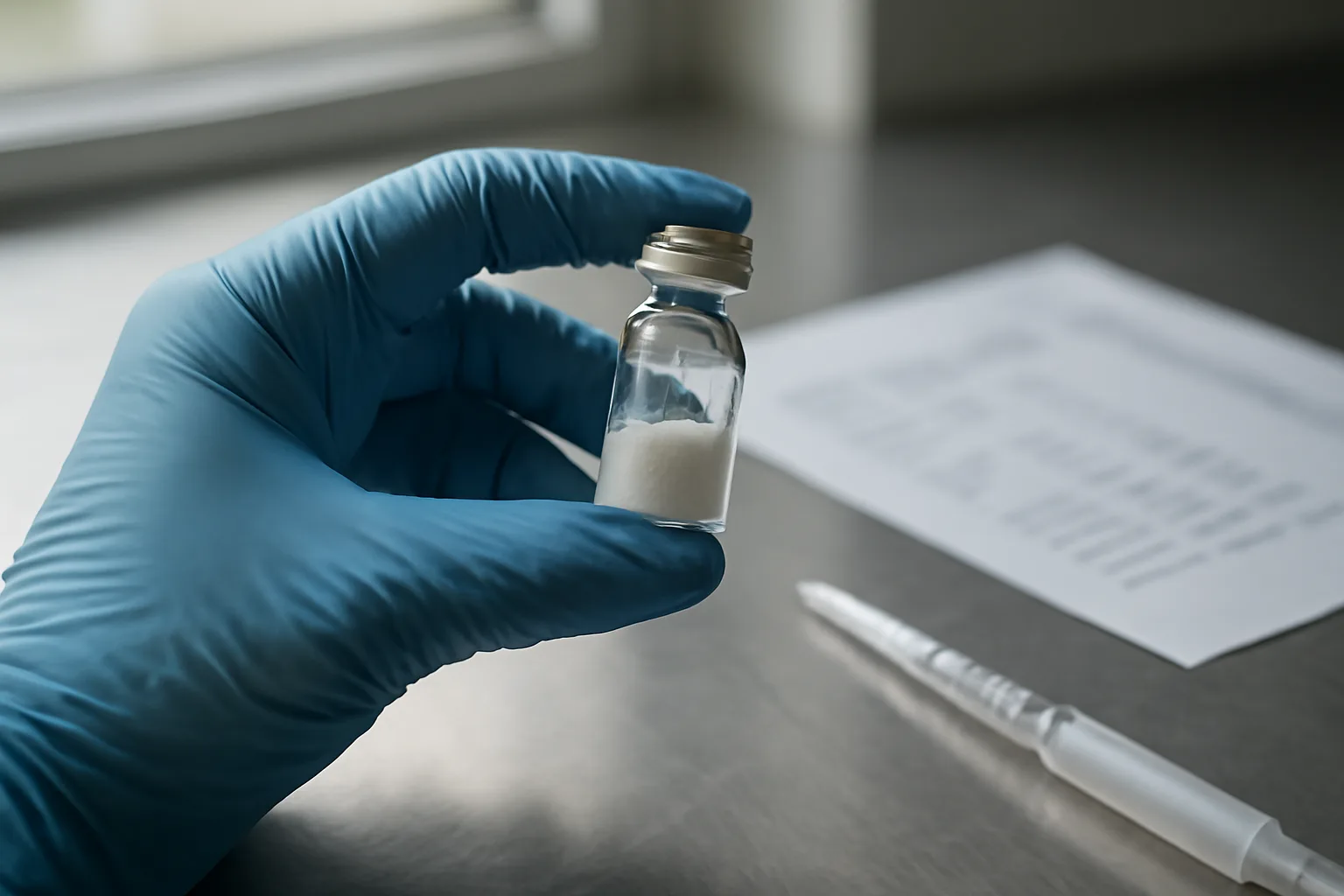
Very little on its own, but a few physical checks are worth doing anyway. Unreconstituted lyophilized (freeze-dried) Epitalon should be a white or off-white powder, compact at the bottom of the vial, not clumped, discolored, or visibly caked to the glass in an unusual way. Once reconstituted with bacteriostatic or sterile water, the solution should be clear, with no visible particulate floating in it and no cloudiness. A cloudy reconstituted solution, visible flecks, or a color shift toward yellow or brown can indicate degradation, contamination, or improper storage, though none of these visual checks confirm purity or identity on their own. Peptides in general are heat-sensitive; lyophilized Epitalon is generally more stable at room temperature short-term than reconstituted solution, which most guidance recommends refrigerating and using within roughly 2-4 weeks, though exact stability windows vary by formulation and aren't independently standardized for this specific peptide. Rubber stopper condition matters too. A vial with a stopper that's been punctured multiple times, is loose, or shows signs of tampering before it ever reaches you is a storage and handling red flag independent of what's inside. None of this replaces lab testing; it's a sanity check you can do in seconds before you even open the box.
How does Epitalon's evidence base compare to other longevity peptides in terms of independent verification?
Epitalon sits at the weaker end of the independent-replication spectrum compared to some other researched peptides, largely because so much of the foundational work is concentrated in one research group and one national literature.
| Factor | Epitalon | Notes |
|---|---|---|
| Primary human data source | Khavinson group, St. Petersburg Institute of Bioregulation and Gerontology [4] | Small cohorts, mostly non-blinded |
| Independent Western replication of lifespan/telomere claims | None found in major peer-reviewed journals | As of current literature searches |
| Animal data | Mouse and rat lifespan/melatonin studies | Rodent findings only; not directly transferable to humans |
| FDA approval status | None | Sold as research chemical, no approved drug use [1] |
| Standard verification method | Third-party HPLC + mass spec COA | No regulatory testing mandate |
This table isn't a knock on the mechanism hypothesis behind Epitalon, which involves plausible biology around pineal gland function and pinealon-related peptide signaling. It's a statement about the evidentiary gap between "a Russian research group reported this in rodents and small human cohorts over several decades" and "an independently replicated, peer-reviewed, randomized controlled trial confirmed this in humans." That second thing hasn't happened yet for Epitalon's core longevity claims.
Where should I actually buy Epitalon if I want a verifiable product?
Buy from a source that shows you a batch-matched, dated, third-party COA before you pay, not after you complain. That's the single filter that does the most work. Beyond the COA, look for sellers who disclose their supply chain (who manufactures, who tests, where), who don't make disease-treatment or human lifespan claims in their marketing (a legal and honesty red flag if they do), and who have a documented reconstitution and dosing protocol that matches what's discussed in clinical and research literature rather than an in-house invention. A provider-reviewed sourcing path, where a pharmacy partner fulfills the order under documented quality controls, is meaningfully different from an anonymous storefront with no named fulfilling party and no traceable batch history. Epitalon Rx's sourcing guidance points toward exactly this kind of provider-reviewed route, naming the fulfilling pharmacy partner rather than shipping product itself, which is worth knowing going in: no legitimate seller in this category should be positioning itself as the manufacturer or compounder. If a site implies it makes the peptide itself, that's itself worth treating with suspicion. Once you've settled on a source, the next practical steps are figuring out dosage, understanding realistic injection protocols, and reading through the known side effect profile before you reconstitute anything.
What should I do if my Epitalon COA doesn't match my vial?
Stop before you use it. If the lot number on the COA doesn't match the lot number on your vial, if the COA is undated, or if the testing lab can't be independently verified online, treat the product as unverified rather than assuming good faith. Contact the seller and ask for the correct, batch-matched documentation. A legitimate operation will have it on file and send it without friction; a seller that gets defensive, delays, or offers a generic "all our products are tested" response instead of the specific document is giving you useful information. Keep records of your communication in case you need to dispute a charge. If you've already reconstituted and used product from a mismatched or undocumented batch and experience any adverse reaction, stop use and consult a physician, and report the event through the FDA's MedWatch adverse event reporting system, which accepts reports on products outside the standard approved-drug pipeline as well [6]. This kind of reporting is also one of the only feedback mechanisms that puts pressure on low-quality suppliers over time, since there's no regulatory inspection doing that work for you.
Frequently asked questions
How can I test Epitalon purity at home?
You can't, not meaningfully. Consumer test kits don't exist for peptide identity or purity at the resolution needed. HPLC and mass spectrometry require lab equipment costing tens of thousands of dollars and trained technicians. The only realistic path is demanding a third-party lab's COA from the seller before you buy, not testing it yourself after.
Is Epitalon legal to buy in the US?
Epitalon isn't FDA-approved for any human use, but it's widely sold as a research chemical labeled "not for human consumption," which exists in a gray zone rather than being explicitly banned for purchase. It has no approved drug or supplement status, so there's no legal framework certifying its quality or safety [1].
What's the difference between Epitalon and epithalon?
Nothing chemically. Both spellings refer to the same synthetic tetrapeptide (Ala-Glu-Asp-Gly), and the variation comes from transliterating the Russian original into English. Neither spelling indicates higher quality or more rigorous testing; check the COA, not the label spelling.
Does a high purity percentage on a COA mean the product is genuine?
Not by itself. A high HPLC purity number tells you the vial is mostly one substance, but only mass spectrometry confirms that substance is actually Epitalon and not a different peptide entirely. You need both an identity test and a purity test to call a batch verified.
Why isn't Epitalon FDA approved if Russian researchers have studied it for decades?
FDA approval requires large randomized controlled trials meeting specific US regulatory standards, and no sponsor has taken Epitalon through that pathway. The existing research, mostly from Vladimir Khavinson's group in St. Petersburg, hasn't been independently replicated at the scale or rigor US or EU regulators require [4][5].
What lab tests confirm a peptide is actually Epitalon and not a fake?
Mass spectrometry (LC-MS or MALDI-TOF) confirms molecular identity by matching the exact mass, around 390 Da for Epitalon's free form. HPLC separately measures purity. A legitimate COA includes both, run by an independent lab, with a batch or lot number matching the vial.
Can Epitalon really lengthen telomeres or activate telomerase in humans?
That specific claim comes from a small body of Russian research, mostly rodent studies and small non-blinded human cohorts, that hasn't been independently replicated in peer-reviewed Western literature. No confirmed human telomere-lengthening effect has been established through the kind of randomized controlled trial that would settle the question.
How much should Epitalon cost if it's properly tested?
Prices vary by vendor and vial size, but genuinely batch-tested product carries real per-batch lab costs (HPLC and mass spec testing aren't free), which tends to put a floor under legitimate pricing. Prices well below the going market range for a 10-20mg vial are a red flag, not a bargain.
What does a Certificate of Analysis need to include to be trustworthy?
A trustworthy COA lists the specific batch or lot number matching your vial, the testing lab's name and location, the test date, the method used (HPLC for purity, mass spec for identity), and a specific purity percentage. Missing lot numbers, dates, or lab names make a COA effectively worthless.
Should I trust a supplier's in-house testing instead of third-party results?
No. In-house testing has an obvious conflict of interest since the seller has a financial incentive to pass every batch. Independent third-party labs with no stake in the sale are the only testing source worth weighing heavily when you're deciding whether a batch is genuine.
Are there sterility or endotoxin concerns with injectable Epitalon?
Yes, if you're reconstituting and injecting it, since research peptides sold this way aren't manufactured under pharmaceutical GMP sterility standards by default. Ask specifically about endotoxin testing (measured in EU/mL) and sterility testing; many vendors run neither unless directly asked.
What should I do if I think I bought fake or contaminated Epitalon?
Stop using it immediately. Contact the seller for batch-matched documentation, keep records of the transaction, and if you've had an adverse reaction, see a physician and consider reporting it through the FDA's MedWatch program, which accepts reports on non-approved products too [6].
Sources
- FDA, Human Drug Compounding: Research peptides sold under 'not for human consumption' labeling exist outside standard FDA drug approval pathways
- FDA, Compounding Laws and Policies: GMP and compounding oversight frameworks apply to registered facilities, not unregistered research chemical vendors
- FDA, Bulk Drug Substances Nominated for Use in Compounding Under Section 503A: FDA has evaluated and flagged certain peptides for compounding safety concerns
- Khavinson VK et al., 'Peptide regulation of aging' review: Foundational Epitalon research comes from Vladimir Khavinson's group at the St. Petersburg Institute of Bioregulation and Gerontology
- Khavinson VK, Anisimov VN, 'Peptide bioregulators as anti-aging tools' PubMed: Epitalon lifespan-extension data comes primarily from rodent studies and small non-blinded human cohorts, not independently replicated RCTs
- FDA, MedWatch: The FDA Safety Information and Adverse Event Reporting Program: Adverse events from non-approved products, including research chemicals, can be reported through FDA's MedWatch system